Blog › Tender-to-Contract Risk
Tender-to-Contract Risk: What Changes Between Pricing and Signing
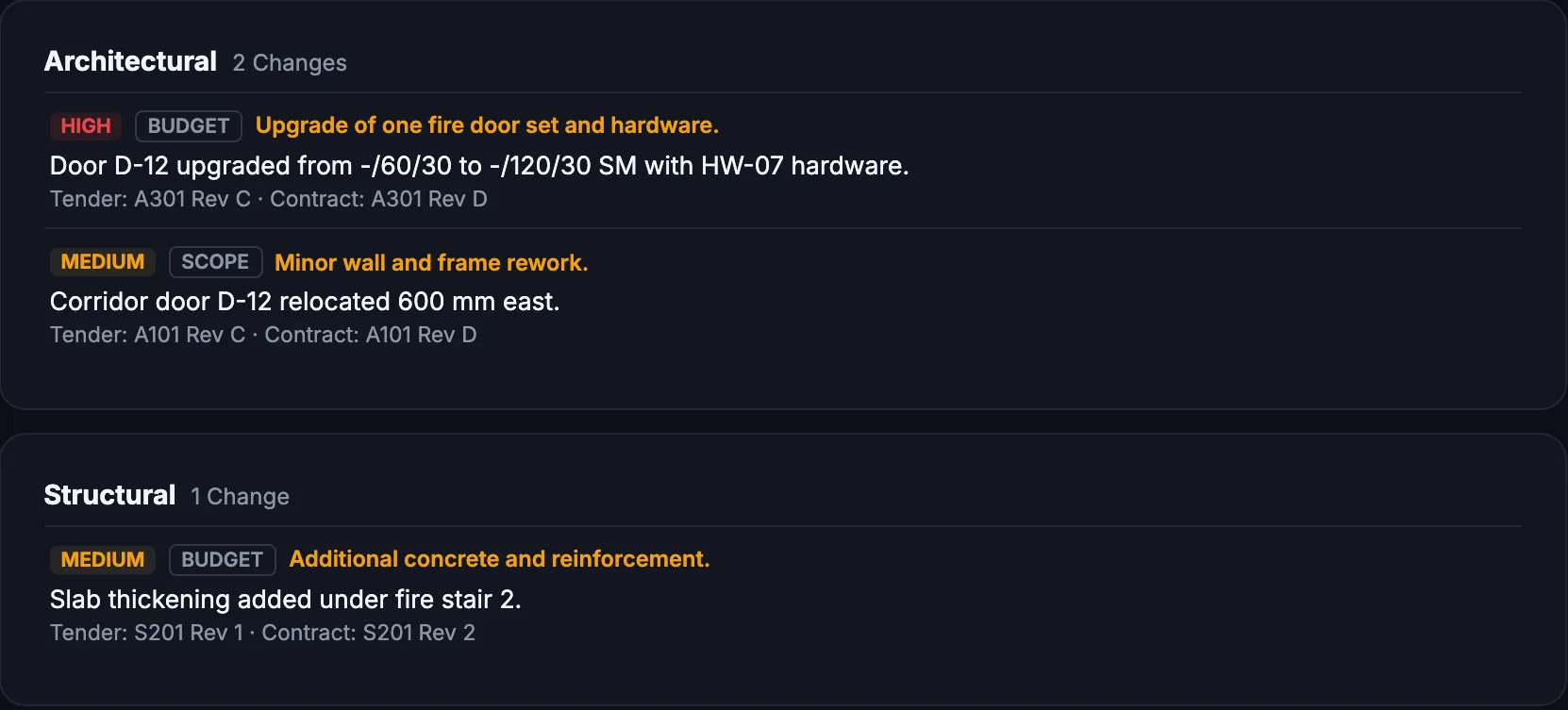
Tender-to-contract risk is the exposure created when the document set you priced at tender is not the document set you sign at execution. Between bid submission and contract execution, the set absorbs addenda, negotiated departures, revised drawings, substituted products and re-issued specifications — and the price rarely moves with them. The only defence is a deliberate, documented comparison of the two sets before signing.
Every experienced estimator has a version of the same story: the job was priced on Rev C architecturals, the contract was executed on Rev F, and the difference — an extra fire-rated wall type, a lift shaft moved two grids, a performance spec swapped for a proprietary one — surfaced six months in, as a dispute rather than a line item.
Why the sets diverge
Nobody sets out to sign a different job than they priced. The divergence is structural:
- Addenda during tender. Most tenders issue two to six addenda. Each supersedes or amends part of the set. If your pricing team didn't trace every addendum through every affected document, your price is already out of sync with the tender set — before the contract set even exists. See addenda in tender periods.
- Post-tender negotiation. Clarifications, departures schedules, value-engineering trades. These get captured in letters and meeting minutes that may or may not be elevated into the contract documents — and the order of precedence determines whether they count. See order of precedence under AS 4000.
- Design development that didn't stop. Consultants keep working between tender close and execution. "For construction" issues land in the contract set carrying changes nobody flagged as changes.
- Substitutions. A specified product becomes unavailable or unaffordable; a "or approved equivalent" swap arrives in the executed spec with different performance characteristics — acoustic ratings, fire ratings, slip ratings — than what was priced.
- Assembly errors. The party compiling the contract binds the wrong revision, omits an addendum, or includes a superseded schedule. This is mundane and constant. It is also why document control matters as much at signing as during delivery.
Where the risk actually hides
The differences that hurt are rarely on the drawings people look at. They hide in:
- Schedules. Door schedules, finishes schedules, fixture schedules. A changed FRL or acoustic rating on one row of a door schedule is invisible in a drawing flick-through and expensive in procurement.
- Specification sections nobody re-reads. Preliminaries, quality clauses, warranty periods, defects liability terms buried in trade sections.
- The gap between documents. A drawing revised to match an addendum while the corresponding spec section wasn't — the conflict now exists inside the contract set, and precedence decides who pays.
- Quantities. Scope drift is usually additive. Extra blockwork, upgraded glazing, an added riser. Individually below the threshold anyone re-prices; collectively material.
- Your own departures. The qualifications you tabled at tender. If they aren't in the executed set — or sit below the drawings in the precedence order — they may as well not exist.
How to review the delta
A workable method, in order:
- Build both registers. List every document in the tender set (as amended by addenda) and every document in the proposed contract set, with revision and date. Mismatched revisions are your first findings — before you've read a page.
- Compare discipline by discipline. Architectural, structural, services, fire, civil. Discipline-level comparison keeps the review tractable and maps each difference to the trade whose price it affects. Full method in comparing tender and contract document sets.
- Compare revised documents sheet by sheet. Where a document appears in both sets at different revisions, compare them — and treat unclouded changes as the priority, because clouded changes at least announced themselves.
- Classify every difference. Budget impact, program impact, scope impact, risk-allocation impact. A difference with no impact is noise; record it and move on. A difference with impact gets a cost, a duration, or a contract note.
- Resolve conflicts the way the contract will. Where documents in the contract set disagree with each other, apply the order of precedence — don't assume the drawing wins because it's newer.
- Convert to instruments. Every material difference becomes either a priced adjustment before execution, a formal qualification, or a question raised in writing. Once the job is running, the same discipline applies through the RFI register.
Who does this, and when
The estimator and the CA, together, before execution — the estimator knows what was priced, the CA knows what the words commit you to. On the principal's side, the superintendent's team should run the same comparison for the opposite reason: to confirm the executed set actually captures the negotiated deal, and that compliance obligations haven't been diluted by a substitution.
The window is short — commercial pressure to execute is real. Which is exactly why the reading layer of this review is worth automating: machine-compare the sets, human-adjudicate the differences. ParitySense runs the tender-to-contract comparison as a structured review — differences by discipline, each with a stated impact type and a citation back to both documents — and a person decides what each one is worth.
The output that protects you
The deliverable is not a feeling of comfort. It is a written schedule of differences: document, revision pair, description, discipline, impact, and the action taken (priced, qualified, queried, accepted). Dated before execution. When a dispute surfaces in month six, that schedule is the difference between "we identified this and dealt with it" and an argument about what everyone knew.
FAQ
Why is the contract set different from the tender set?
Between tender close and execution, the set absorbs addenda, post-tender negotiation, revised drawings, substituted specifications and departures schedules. Each change is individually small; collectively they can move scope, risk allocation and price basis without anyone re-pricing the whole job.
Who should run the tender-to-contract comparison?
On the contractor side, the estimator who priced the job plus the contract administrator who will run it. The estimator knows what was priced; the CA knows what the words commit you to. Neither review alone is sufficient.
How long does a tender-to-contract review take?
Manually, one to three days for a mid-size commercial package done discipline by discipline. Automated cross-referencing cuts the reading time substantially, but a human still adjudicates every flagged difference — the review is faster, not skipped.
What happens if you sign without comparing the sets?
You inherit every post-tender change at your tendered price: upgraded performance specifications, revised drawings adding quantity, and departures you tabled at tender quietly absent from the executed documents.
Run it through ParitySense alongside your manual review and measure the delta.
See how it works