Blog › Tender-to-Contract Risk
RFIs That Actually Get Answered
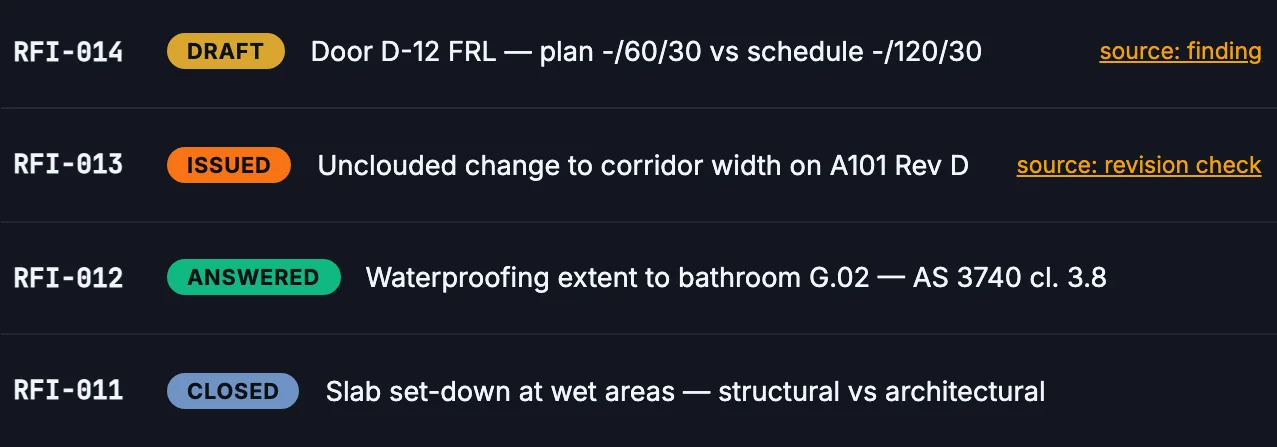
A request for information (RFI) is a numbered, written question from one contracting party to another — typically contractor to superintendent or design team — seeking clarification of the contract documents. It is also, whether anyone intends it or not, evidence: of when an issue was known, what was asked, and what was answered. The RFIs that get answered fast share the same traits — one question, cited evidence, a proposed answer, a real due date — and the register that protects you at claim time shares one trait above all: nothing is ever deleted from it.
One question, one RFI
The single highest-leverage habit. An RFI containing five questions gets answered when the hardest of the five is ready — the four easy answers sit hostage to the one that needs a structural engineer's sign-off. Worse, a partially answered multi-question RFI has no honest status: not open, not closed, unreportable.
Split them. Five questions, five RFIs, five clocks. Each closes when its answer lands. Your register stays truthful and your weekly report writes itself. The apparent overhead of "more RFIs" is nothing next to the cost of question three of RFI-041 being quietly forgotten.
Evidence in, answer out
An answerable RFI does the respondent's homework:
- Cite both sides of the problem. "Drawing A-102 Rev F, Detail 5, shows a 90-minute door to Stair 2; door schedule A-951 Rev D, item D-2.14, states -/60/30. Which applies?" A question with document, revision, page and the exact conflicting statements can be answered in a sentence. "Please clarify door ratings" cannot, and will circulate for a fortnight.
- Propose an answer. "We propose the schedule governs per the contract precedence order and will procure -/60/30 unless directed otherwise by [date]." A yes/no confirmation is the cheapest response you can ask a consultant for — and where the contract documents conflict, framing your proposal around the order of precedence shows the respondent you've already done the resolution logic.
- Attach the pages, not the set. Marked-up extracts of the relevant details. The respondent should never need to open a drawing register to understand the question.
- Give a due date tied to a consequence. "Response required by 21 September to hold the Level 3 fit-off" is a date someone will defend in a program review. "ASAP" is a date nobody owns.
RFIs and time bars — keep the instruments straight
An RFI is usually the first written trace of an issue, but under most Australian contracts it is not the contractual notice. AS 4000-style and bespoke contracts alike impose separate notification requirements for claims — often with short, strict timeframes — and security of payment legislation in each state runs its own clocks entirely. The failure mode is familiar: the team raises a thorough RFI, waits six weeks for the answer, and only then thinks about notices — by which point a time bar may already have closed over the claim.
Practical rule: when drafting any RFI, ask whether the underlying issue could carry cost or time consequences. If yes, the RFI and the contractual notice are two separate documents issued in parallel, with the RFI cited in the notice as supporting record. Do not let the question stand in for the notice.
Never delete. Void with a reason, keep the number.
RFI numbers escape into the wild immediately — quoted in site instructions, meeting minutes, subcontractor correspondence, later RFIs, eventually claims. Delete RFI-023 and every one of those references dangles; at adjudication, a sequence that runs 022, 024 is not a tidy register, it's a question: what was 23, and why is it gone?
The correct mechanism: mark it void or withdrawn, record the reason ("duplicate of RFI-019", "superseded by SI-domain change", "raised in error"), keep the number, render it struck-through in the register. The record shows a question was raised and deliberately retired — which is information, not clutter. The same non-destructive principle applies across the document set; it's the core of sound document control: supersede, never erase.
Draft automatically, send deliberately
Most RFIs are born from a document event: a revision arrives with an unclouded change, a spec conflicts with a schedule, an addendum contradicts a drawing. That origin story is exactly what makes drafting automatable — the change is known, the citations exist, the affected trade is known. ParitySense auto-drafts RFIs from detected changes with the evidence already attached.
Sending is different in kind. An RFI can start response clocks, shape claim positions and create time-bar exposure — it is a contractual instrument, and it goes out under a human's name after a human has read it. In a well-run system that boundary is architectural, not cultural: the machine can draft; only a person can press send, and the audit trail records who did. The reasoning is the same as for any AI-assisted decision with professional consequences: assistance scales, accountability doesn't.
FAQ
Why should an RFI contain only one question?
An RFI with five questions gets answered when the hardest one is ready — the four easy answers wait too. One question per RFI lets each item close on its own clock, keeps the register's status honest, and makes each answer separately traceable.
Why should you never delete an RFI?
The number is a contractual reference other correspondence may already cite. Deleting it breaks those references, and a gap in the sequence invites the question of what was removed and why. Void with a recorded reason and keep the number.
How do RFIs relate to contractual time bars?
An RFI is often the first written record of an issue but usually not the contractual notice. If the issue could carry cost or time consequences, issue the required notice in parallel and cite the RFI as supporting record.
Can AI draft RFIs?
Yes — well, when working from a specific detected change or conflict with citations attached. But an RFI starts clocks and carries contractual weight, so a human must review, own and send every one.
Run it through ParitySense alongside your manual review and measure the delta.
See how it works