Blog › Tender-to-Contract Risk
Comparing Tender and Contract Document Sets: A Practical Method
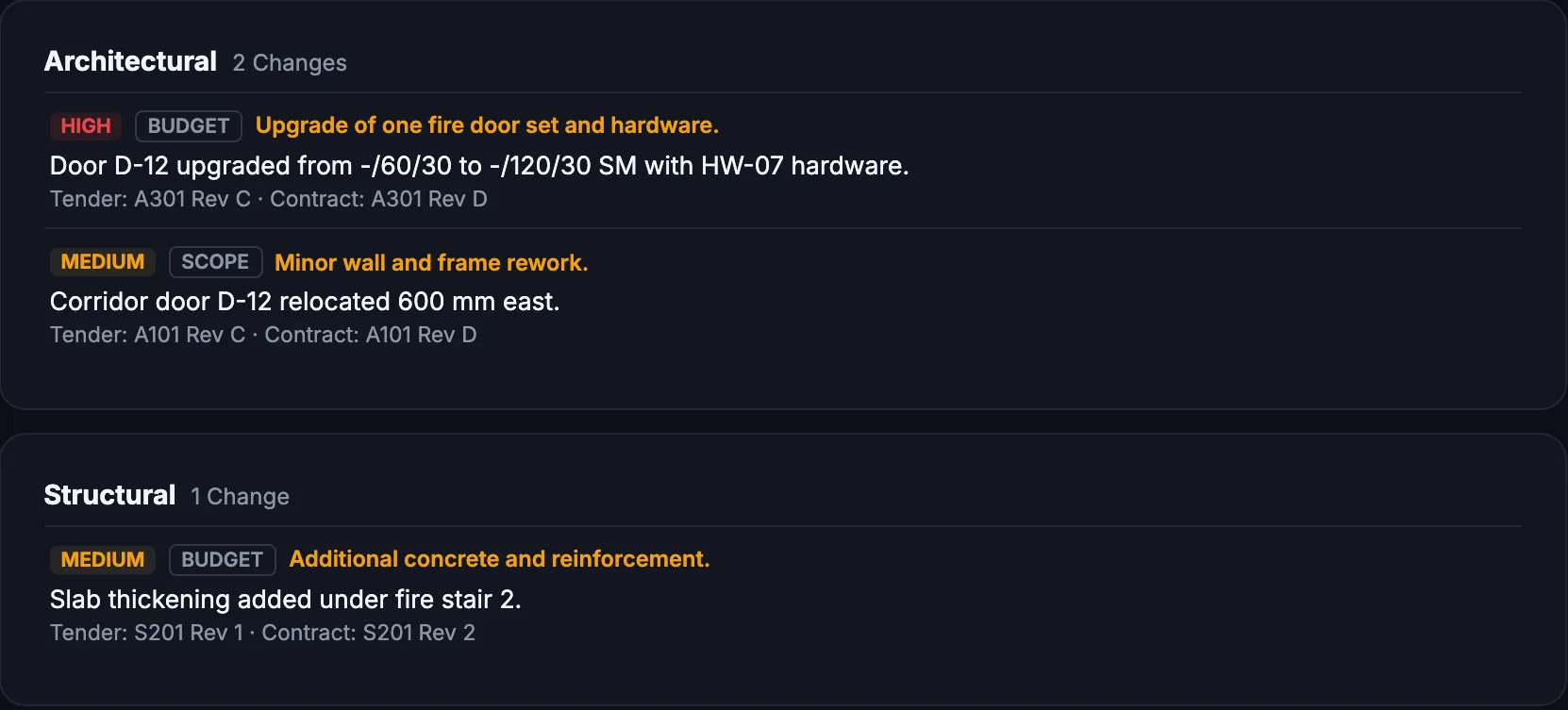
A tender-to-contract comparison is a structured review that identifies every difference between the document set a contractor priced and the document set the parties are about to execute, then classifies each difference by budget, program and scope impact. Done properly, it produces a schedule of differences you can price, qualify or query before signing — not a vague sense that "the set has moved". This article is the working method; the tender-to-contract risk guide covers why the sets diverge in the first place.
Step 1 — Reconcile the registers before reading anything
Build two lists: the tender set as amended by every addendum, and the proposed contract set. Document number, title, revision, date. Then match them. Three outcomes per row:
- Same revision in both — park it. No further reading required unless it's referenced by a changed document.
- Different revision — this is your reading list. Every one of these needs a page-level comparison.
- Present in one set only — the highest-risk category. A drawing added to the contract set was never priced. A tender document missing from the contract set may have carried a qualification you rely on.
Most reviews skip this step and start reading. Don't. Half your material findings fall out of the register comparison alone, and it scopes the rest of the work honestly.
Step 2 — Compare discipline by discipline
Work through the changed-revision list grouped by discipline: architectural, structural, hydraulic, mechanical, electrical, fire, civil, then the specification trade sections that correspond. Two reasons this beats a document-order pass:
- Impact lands by trade. A difference in the structural set hits the structural package price and the structural program. Grouping by discipline means each difference is born already attached to the budget line it affects.
- The right eyes see the right pages. Your services coordinator reviews the services delta; your estimator reviews the quantities-bearing sheets. Nobody reviews everything, and nothing is reviewed by nobody.
Within each discipline, compare revision pairs page by page. Clouded changes are the easy part — the author told you where to look. The dangerous ones are unclouded: a dimension nudged, a schedule row edited, a note deleted. Machine comparison earns its keep here; a side-by-side comparison with the changes listed turns an hour of squinting into minutes of adjudication. Discipline for tracking clouded versus unclouded changes is the same one covered in addenda management — the tender period is where the habit should start.
Step 3 — Classify every difference
Each difference gets one line in the schedule: documents and revisions, page, description, discipline, and an impact classification:
- Budget — changes quantity, quality, or performance requirement. Gets a cost, even a rough one. "$8–15k, glazing upgrade, level 3 north" beats "TBC".
- Program — changes sequence, lead time or duration. A substituted product with a 14-week lead time is a program finding even if cost-neutral.
- Scope — moves the boundary of what you're delivering. Added rooms, added systems, transferred design responsibility.
- Risk / contractual — changes who carries what: warranty terms, fitness-for-purpose language, latent conditions wording, precedence order. These go to whoever negotiates the contract, and they interact directly with the order of precedence — a difference that sits low in the precedence order may cost you nothing; the same words high in the order may cost you the argument.
- Nil — record and close. The schedule must show the difference was seen and judged, or it proves nothing.
Step 4 — Convert findings to actions before execution
A schedule of differences that ends in a drawer is theatre. Each material line resolves one of four ways, in writing, before signing:
- Priced — a contract sum adjustment agreed pre-execution.
- Qualified — a departure or clarification incorporated into the contract documents, placed where the precedence order gives it effect.
- Queried — a written question with the difference cited as evidence. If it stays unresolved past execution it becomes an early RFI; the standards for a query that actually gets answered are in RFI best practice.
- Accepted — a deliberate, recorded decision to wear it. Legitimate, as long as it's a decision and not an oversight.
What the finished review looks like
One register reconciliation, one schedule of differences by discipline with impact classifications, one action column fully populated, all dated before execution. On a mid-size commercial job expect 30–150 differences, of which perhaps a dozen are material. The value is concentrated in those dozen — but you only find them by clearing the rest, which is precisely the part worth handing to a machine while a human keeps the judgement.
FAQ
Why compare discipline by discipline rather than document by document?
Because impact lands by trade. A structural change affects the structural subcontract price and program; comparing by discipline maps each difference directly to the package it hits, and lets the right reviewer look at the right differences.
What counts as a material difference?
Anything that changes cost, time, scope boundaries, performance requirements or risk allocation. A retitled drawing is not material; a door schedule row moving from FRL -/60/30 to -/120/30 is.
Should differences with no cost impact still be recorded?
Yes. Record them with a nil-impact classification. The schedule of differences is only defensible if it shows you reviewed everything, not just what you decided was expensive.
Run it through ParitySense alongside your manual review and measure the delta.
See how it works