Drawing Register Best Practices: Building One That Survives an Audit
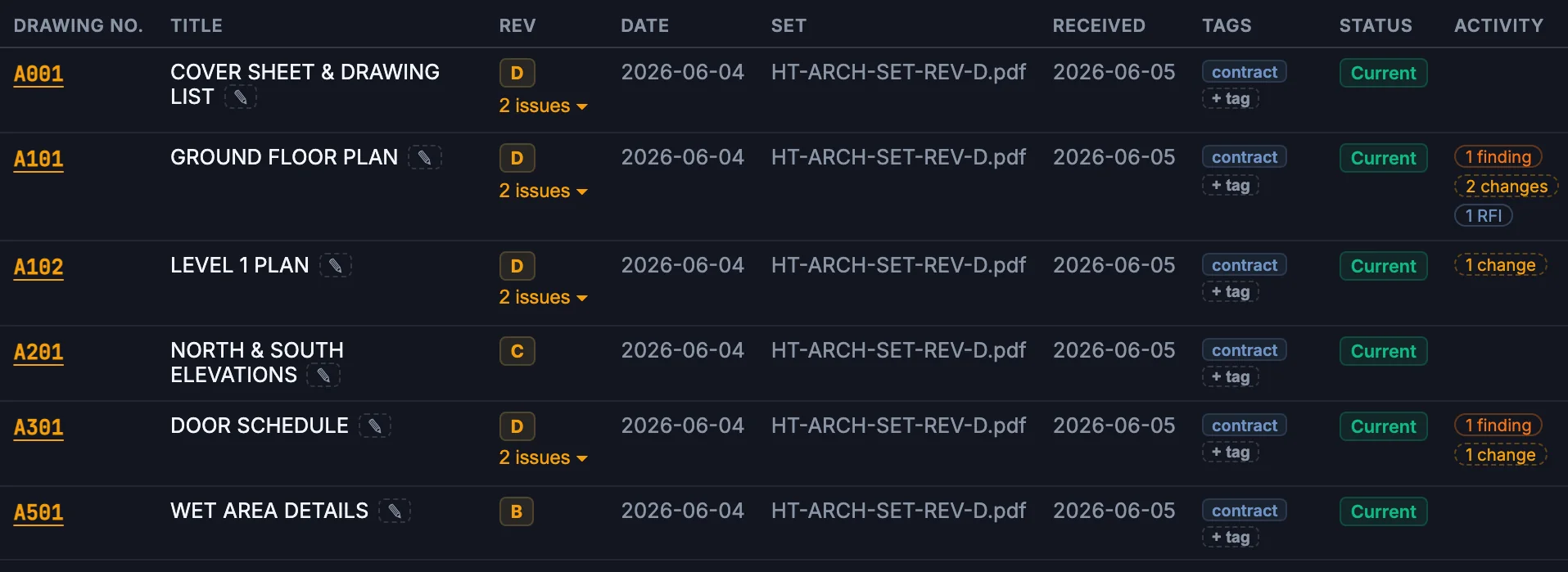
A drawing register is the authoritative index of every drawing on a project: its number, title, discipline, current revision, status and issue history. Its job is to answer two questions instantly and defensibly: what is the current revision of this document? and who held which revision on a given date? If your register can answer both under cross-examination, it is doing its job. Most cannot.
The fields that matter
Registers fail more often by omission than by error. The working minimum:
- Document number — exactly as it appears in the title block, not normalised by hand. If the consultant writes A-102, do not record A102; you will search for the wrong string later.
- Title — again verbatim. Title drift between revisions ("Level 2 Plan" becoming "Level 02 Floor Plan") is itself a signal worth recording.
- Discipline / category — architectural, structural, hydraulic, fire, and so on. This is what lets you filter a 900-row register into something a reviewer can use.
- Current revision and revision date — the date on the drawing, not the date you filed it. Keep both if you can; the gap between them is your processing latency, and it is worth watching.
- Status — current, superseded, void. Never delete a row; see superseding without destroying history.
- Issue purpose — for information, for tender, for construction. A "for construction" drawing carries different weight from a preliminary issue, and the register must show which was which and when the status changed.
- Issue history — every revision ever received, with transmittal reference and date. This is the audit spine. A register showing only current state cannot reconstruct what the formworker held in March.
One register, one owner
The classic failure is three registers: the architect's issued list, the head contractor's Aconex workspace, and the site office spreadsheet. Each is locally true and globally inconsistent. Pick one as authoritative — usually the head contractor's — and reconcile the others against it monthly. The reconciliation itself is a ten-minute comparison that surfaces real problems: drawings issued but never registered, revisions registered but never issued to the parties holding the prior revision.
Registering revisions without falling behind
The register decays when intake outruns capacity. A transmittal of 140 revised drawings should not require 140 manual title-block readings. Two practices keep the register live:
- Register on receipt, review later. The row update — number, revision, date, status flip on the prior revision — happens the day the transmittal arrives, even if the technical review of what changed happens next week. A register that is complete but shallow beats one that is deep but three weeks stale.
- Extract, don't transcribe. Title-block extraction gets the number, revision and date out of the PDF automatically and pairs the new revision with its predecessor. The human confirms rather than types. The prerequisite is halfway-consistent title blocks, which is its own discipline — see title blocks and document numbering.
What the register cannot tell you
A register records that A-102 moved from Rev C to Rev D. It says nothing about what changed — and the amendment note in the title block ("general revision", "updated per RFI 034") is a summary written by the person least motivated to itemise it. The changes that hurt are the ones with no cloud and no note; catching those requires comparing the revisions themselves, which is the subject of unclouded revision changes. A good register plus revision comparison is the pairing that actually protects you; the register alone is necessary but not sufficient. That pairing is the core of the ParitySense revision workflow: extract, register, pair, compare, then hand the decision to a human.
Register hygiene rules
- Never overwrite a row. Revisions append; status changes are logged with actor and timestamp.
- Never register a document you cannot open. A corrupt PDF registered as current is worse than a gap.
- Record voids explicitly. A drawing withdrawn from the set gets status void with a reason, not a deleted row — the numbering gap will be asked about.
- Export monthly and keep the exports. A dated series of register snapshots is cheap insurance; it proves the state of your knowledge at each point in time.
FAQ
What should a drawing register contain?
Document number, title, discipline, current revision and date, status, issue purpose, and full issue history with transmittal references. The issue history is what makes it defensible.
Who should own the register?
One party, usually the head contractor's document controller or CA. Other parties' lists get reconciled against it monthly, not maintained in parallel as equals.
How often should it be reconciled?
Row updates on receipt of every transmittal; reconciliation against consultants' issued lists at least monthly during design development.
Does Aconex or Procore replace it?
They hold documents and transmittals, but you still need the one-row-per-document register view with full history. Disputes are argued from register exports.
Run it through ParitySense alongside your manual review and measure the delta.
See how it works