Title Blocks and Document Numbering: The Foundation of Automation
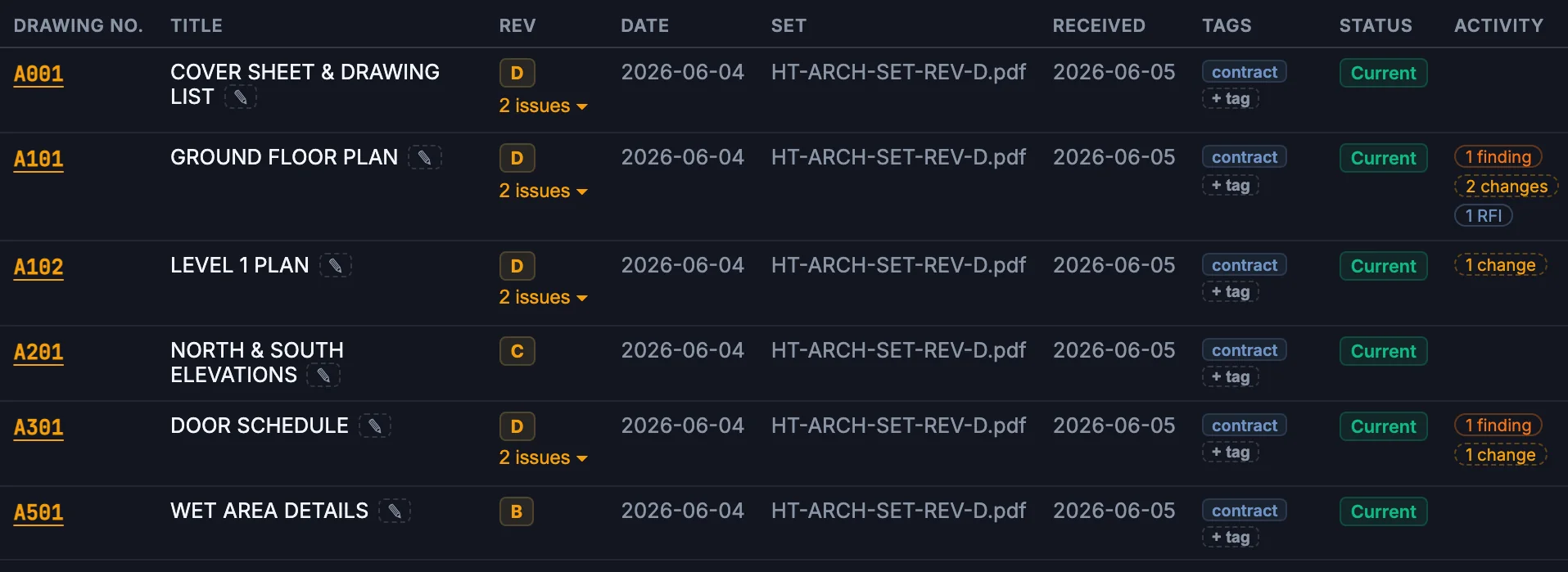
The title block is the machine-readable identity of a drawing: number, title, revision, date, issue purpose and amendment history in a fixed location on every sheet. Every piece of document automation — register maintenance, classification, revision pairing, change detection — starts by reading it. When title blocks are consistent, a document set effectively files itself. When they are not, every automation downstream degrades into guesswork, and the humans go back to typing register rows by hand.
What "inconsistent" actually looks like
Not chaos — small, reasonable-looking divergence. From real project sets:
- The same drawing issued as
A-102,A102andA.102across three transmittals, as the architect's office moved between template versions. - Revision recorded as
D,Rev D,REV.Dand4— the structural engineer numbering revisions while everyone else letters them, then switching to letters at "for construction". - Dates as
03.09.26,3/9/2026andSEP 26— and one office issuing with the CAD plot date instead of the revision date. - The hydraulic consultant embedding revision in the filename (
H1002[C].pdf) but leaving the title-block revision cell showing the previous letter. - Sheet titles drifting between revisions: "Level 2 Plan" becomes "Level 02 Floor Plan" at Rev D, breaking any title-based matching.
A human absorbs each of these without noticing. A register keyed on exact strings — or a pairing algorithm trying to match new revisions to old — sees five different documents where there is one.
Why pairing is the automation that matters
Of everything a title block feeds, prior-version pairing is the highest-stakes consumer. Recognising that the file that just arrived is A-102 Rev D, and that it replaces A-102 Rev C, is the trigger for the whole revision chain: supersede the predecessor, compare the pair, surface unclouded changes, carry the review forward. A missed pairing means a revision enters the set as a "new" document — no supersede, no comparison, the old revision still marked current. A wrong pairing is worse: the comparison pairs unrelated sheets and the register chain corrupts. Good extraction therefore reports confidence, not just values: a clean read pairs automatically; an ambiguous one is presented to a human with a best guess pre-selected. That threshold-and-review pattern is how the ParitySense intake pipeline is built — silent when certain, asking when not.
What to standardise, and when
The leverage is all at project start. A numbering and title-block schema costs a page in the document control procedure or BIM execution plan; retrofitting it across five consultant offices mid-project costs weeks of friction. Standardise:
- Number format. One pattern per discipline — originator, discipline code, sheet number — with separators fixed. Whether you adopt an AS 1100-style drafting practice or a project-specific schema matters less than everyone using the same one.
- Revision convention. Letters or numbers, when the sequence resets (commonly at "for construction"), and how preliminary issues are marked. Mixed conventions are the single biggest cause of failed pairing.
- Fixed cells. Number, revision, date and status in the same title-block position on every sheet of every discipline. Extraction from a known region is dramatically more reliable than searching a whole sheet.
- Real text, not outlines. PDFs exported with text intact extract cleanly; sheets plotted as raster or with fonts converted to curves force OCR, which is where
O/0andI/1errors in document numbers come from. Specify vector PDF with live text in the deliverables clause. - Issue purpose vocabulary. A closed list — for information, for tender, for construction — not free text. "Issued for coordination purposes" defeats any status logic.
Living with imperfection
No project achieves full consistency; consultants join late, templates drift, legacy sheets get reissued. The workable posture: normalise on intake (strip separators and case for matching, but record the verbatim string in the register), review every low-confidence extraction rather than letting it guess, and feed corrections back — a system that remembers that this consultant's "Issue 4" means "Rev D" stops asking. Metadata quality is not a one-off setup task; it is a small standing tax that buys back the hours currently spent transcribing title blocks into spreadsheets, and it is the precondition for everything else in document control that you would rather not do by hand.
FAQ
What should a title block contain?
Document number, title, revision, revision date, issue purpose, scale and the amendment schedule — in fixed positions, as live text, identical across disciplines.
Why does inconsistent numbering break automation?
Register maintenance and revision pairing key on the document number. If one document appears under three string variants, the system sees three documents, pairing fails, and superseding and comparison fail with it.
What is title-block extraction?
Automatically reading number, title, revision and date from the PDF to populate the register and pair revisions — with confidence scoring and human review of uncertain reads.
Can numbering conventions be enforced on consultants?
Specify them at engagement in the document control procedure or BEP, ideally referenced from the consultant agreement. Before mobilisation it is a paragraph; after, it is a negotiation.
Run it through ParitySense alongside your manual review and measure the delta.
See how it works