Blog › Tender-to-Contract Risk
Order of Precedence Under AS 4000: How Conflicting Documents Get Resolved
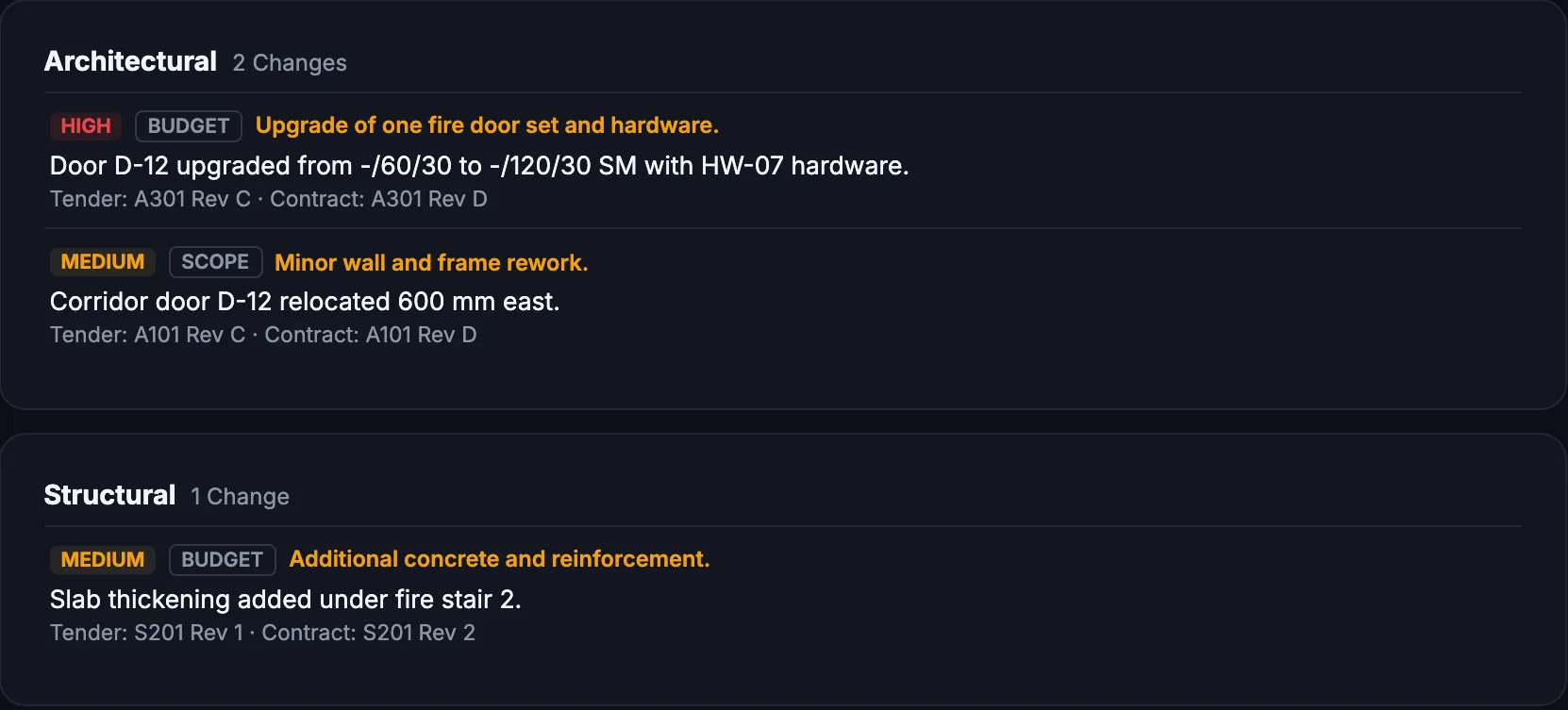
Order of precedence is the contractual ranking that determines which document prevails when two contract documents conflict. Under AS 4000 — the most widely used Australian general conditions for construct-only contracts — clause 8.1 deals with discrepancies between contract documents and establishes how they are resolved, including by reference to an order of precedence where the contract states one. The practical point for anyone reviewing a document set: a conflict between documents is not resolved by common sense, recency, or who shouts loudest. It is resolved by the ranking — and your review should apply the same ranking, or your findings will be wrong.
Why precedence exists at all
A construction contract is an assembly: formal instrument of agreement, general conditions, special conditions, specification, drawings, schedules, sometimes a BoQ and post-tender correspondence. These documents are written by different people at different times and they disagree — routinely. A spec calling for one door hardware suite while the door schedule shows another. A drawing note contradicting a trade section. Preliminaries imposing a warranty period the special conditions have already changed.
Without a ranking, every such conflict is a negotiation. With one, most conflicts have a mechanical answer: the higher document prevails to the extent of the inconsistency. That's the whole design — convert arguments into lookups.
The typical shape of the ranking
Precedence orders vary contract to contract, but the common pattern in Australian practice runs from the most-negotiated document to the least:
- The formal instrument of agreement and any special conditions;
- The general conditions (e.g. AS 4000 as amended);
- The specification;
- The drawings;
- Schedules, BoQ and other annexed documents.
Note what this implies: text generally beats drawings. That surprises site teams every time, because construction is delivered from drawings. But the specification usually outranks them — so when a drawing shows a lower-performance assembly than the spec describes, the spec's requirement typically stands, and pricing off the drawing alone was the mistake. Always verify the actual clause in the executed contract, because amended forms reorder this list constantly, and some contracts instead declare the documents mutually explanatory with discrepancies resolved by the superintendent's direction.
What AS 4000's discrepancy mechanism asks of you
Under AS 4000, when a party discovers an inconsistency, ambiguity or discrepancy in the contract documents, the machinery is: notify it, and the superintendent directs the resolution. Two practical consequences:
- Silently picking a reading is a bet. Build to the cheaper interpretation without notifying, and if the direction later goes the other way you may wear rework with a weakened claim position. Notification preserves your entitlement arguments; the direction can carry cost and time consequences dealt with under the contract.
- Discovery timing matters commercially. A discrepancy found during tender review becomes a clarification or a qualification. Found during the tender-to-contract comparison, it becomes a pre-execution fix. Found in month eight, it becomes a notified discrepancy, a direction, and probably a fight about who should have seen it. Same words on the same pages — the price of the conflict is set almost entirely by when you find it.
Reviewing with precedence in mind
This is the discipline most document reviews miss. Finding a conflict is half the job; the finding is only useful if it's resolved the way the contract will resolve it:
- Record both sides with citations. Document, revision, page, the exact stated requirement on each side. A conflict finding without both citations is an anecdote.
- State which document prevails under the applicable precedence order — from the executed contract's clause, not the unamended standard form.
- Price and plan to the prevailing requirement, and flag the residual: if the prevailing answer is commercially wrong for you, that's a qualification to negotiate or a discrepancy to notify — not a reason to quietly adopt the losing document.
This is how ParitySense's precedence check is built: when cross-document checks find a drawing/spec/schedule conflict, the finding carries both citations and a proposed precedence resolution — and a human confirms it, because reading the executed precedence clause is judgement work, not pattern-matching. The same conflicts also tend to be exactly the questions worth raising early through a well-formed RFI.
The one-sentence version
Conflicts between contract documents are inevitable; the precedence order is the contract's answer key; a review that finds conflicts without resolving them per that key produces findings the contract will overrule.
FAQ
What is order of precedence in a construction contract?
A contractual ranking of the documents that make up the contract, used to resolve conflicts between them. When two documents say different things about the same subject, the higher-ranked document prevails to the extent of the discrepancy.
Does the newest document automatically win a conflict?
No. Recency is not precedence. A newer drawing does not override a higher-ranked specification just because it was issued later — unless the contract's precedence order or a formal variation says so.
What should you do when you find a discrepancy between contract documents?
Notify it in writing per the contract's discrepancy mechanism and seek a direction, rather than silently building to your preferred reading. Under AS 4000 the superintendent directs the resolution, and that direction can carry cost and time consequences worth preserving.
Do all Australian contracts use the AS 4000 precedence approach?
No. Bespoke and amended contracts frequently rewrite the precedence clause, reorder the documents, or declare the documents mutually explanatory with no ranking. Always read the precedence clause of the actual executed contract.
Run it through ParitySense alongside your manual review and measure the delta.
See how it works