Why AI Must Never Sign: Professional Sign-Off in AI-Assisted Review
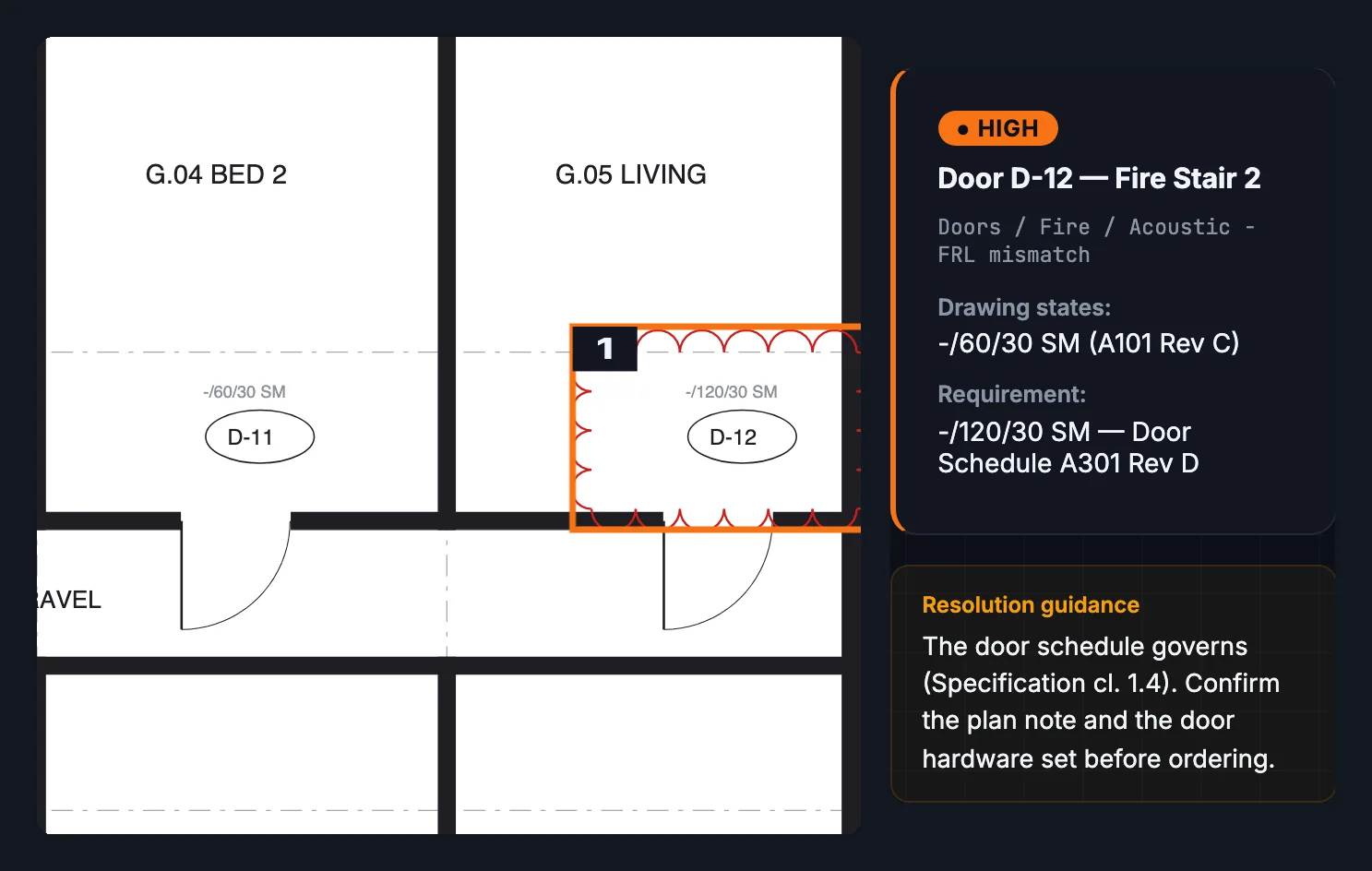
Professional sign-off is the act by which a qualified person — a building surveyor, certifier, engineer, or a contract administrator issuing a formal position — puts their name, and everything attached to their name, behind a conclusion. AI can accelerate every step that leads to that moment. It must never perform the moment itself. This is not a compliance nicety we've bolted onto a product; it is a structural fact about how accountability works in Australian construction, and any tool built as if it were optional is a tool built for someone else's industry. (What follows is practical framing from people who build review software, not legal advice — your obligations come from your registration scheme, your contract and your insurer, and those are the authorities to consult.)
Accountability doesn't compress
Consider who signs things on an Australian project. The building surveyor or certifier whose approval sits within a statutory registration scheme, with a board that can discipline them personally. The engineer whose design certification carries their registration in the growing number of states that require one. The superintendent certifying payment or assessing a claim under the contract. The CA whose formal correspondence creates positions their employer will live with in adjudication under security of payment legislation.
Every one of these acts shares a property: it binds a person — their registration, their professional indemnity insurance, their standing. That is deliberate. The system works because someone identifiable can be asked, later and under pressure, "why did you conclude this?" — and must have an answer. Software cannot hold a registration, owe a professional duty, appear before a board, or carry PI cover. A tool that "signs" hasn't absorbed the accountability; it has merely obscured which human is actually carrying it — usually the one who clicked fastest.
What "review aid" honestly means
So the ceiling for AI in this domain is fixed, and the honest product question is what fits underneath it. Quite a lot does:
- Reading and cross-checking the entire set — the mechanical layer where machines genuinely outperform sampled human review (the capability case, and the failure modes, are in the honest guide).
- Surfacing candidate findings with evidence attached, so the professional adjudicates claims rather than hunts for them — provided every claim is citation-backed, which is the point of evidence gating.
- Drafting instruments — RFIs, comparison schedules, report sections — for a person to review, amend and issue.
And the line it must not cross: the tool never decides a finding is confirmed, never sends correspondence, never issues a report. In ParitySense that boundary is enforced in the architecture — the system has no code path that confirms a finding or dispatches an RFI without a named human acting, and the workflow is built around that adjudication step. We'd make the same recommendation about any competitor: if the boundary is a policy, it erodes under deadline pressure; if it's architecture, it holds.
The audit trail is what makes assistance defensible
Here is the part that decides whether AI assistance strengthens or weakens your position when a conclusion is later challenged. The question that arrives — from a board, an insurer, an adjudicator, opposing counsel — is always some form of "demonstrate how this decision was reached." A defensible answer separates machine work from human judgement, with records for both:
- What ran: which checks, on which documents at which revisions, when.
- What was found: each candidate finding with its citation to the evidence — and, just as importantly, what the system withheld as unverified.
- What the human did: confirmed, dismissed with reason, corrected, escalated — per finding, with actor and timestamp.
- What was issued: which report or correspondence went out, containing which confirmed findings, sent by whom.
Notice what this record does to the AI-assistance question: it dissolves it. "Did a machine help?" becomes uninteresting when you can show that every finding in the signed report was individually verified against a cited page by a named professional. Conversely, a process that can't produce this record is fragile whether or not AI was involved — the transcript of a chat session is not an audit trail, because a surveyor must be able to demonstrate the reasoning without replaying a conversation. This is the same logic your profession already applies to the RFI register: numbered, nothing deleted, every action attributable. AI-assisted review just extends the register discipline to the review itself.
The position worth holding
Sceptics in your office are right that a machine's opinion is worth nothing at sign-off. Enthusiasts are right that unassisted humans cannot exhaustively cross-check a modern document set. Both are answered by the same arrangement: the machine reads everything and proves what it claims; the professional judges everything that matters and signs; the record shows exactly where one ended and the other began. Tools should be evaluated on how well they implement that arrangement — and rejected, whatever their demo looks like, if they blur it.
FAQ
Can an AI tool certify or sign off construction documents?
No. Certification and sign-off attach to registered, qualified people who carry personal and professional accountability for the conclusion. Software cannot hold a registration, owe a duty, or be disciplined by a board — it can only help the person who signs.
If AI found the issue, who is responsible for the conclusion?
The professional who adopts it. Relying on a tool does not transfer responsibility to the tool or its vendor as a practical professional matter — which is exactly why AI output must be checkable against cited evidence before the signer makes it their own.
What makes AI-assisted review defensible after the fact?
A record separating machine work from human judgement: which checks ran, what was found with what evidence, what the reviewer confirmed, dismissed or corrected, and who signed what when. If reconstructing the decision requires replaying a chat transcript, the process is not defensible.
Should a review report disclose that AI was used?
Expectations are still settling, but the conservative position is simple: be able to show, on request, exactly what the tool did and what the human decided. A tool that produces that record makes disclosure a non-event.
Run it through ParitySense alongside your manual review and measure the delta.
See how it works