AI for Construction Document Review: An Honest Guide
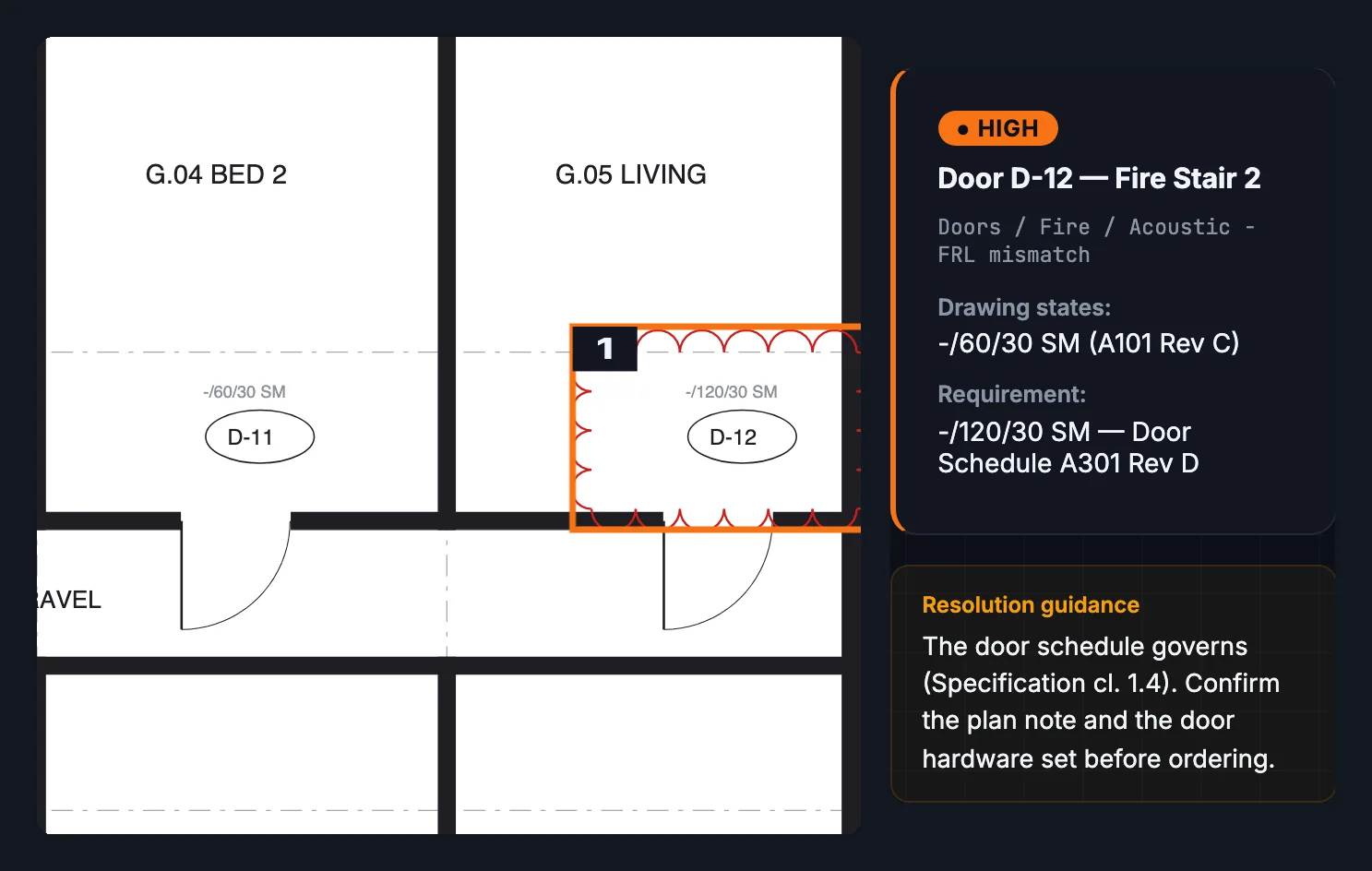
AI construction document review is the use of machine learning — primarily large language models and computer vision — to read, cross-reference and check construction documents: drawings against schedules, specifications against standards, revisions against their predecessors. We build one of these tools, so read what follows with that in mind. But the sales pitch you'll hear across this category — "AI checks your documents" — is incomplete in a way that matters professionally, and an honest account of where these systems fail is more useful to you than another demo. Here is that account.
What AI genuinely does well
Three capabilities are real, and they compound:
- Reading at scale. A 400-page specification, sixty drawings, four schedules and a geotech report is a week of human reading before analysis even starts. A machine reads all of it in minutes and — critically — reads page 380 with the same attention as page 3. Human review quality degrades over a long set; machine reading doesn't fatigue. For the mechanical layer of review — what does each document actually state? — this is a genuine step change.
- Cross-referencing. The most valuable checks in construction review are cross-document: does the door schedule's FRL match the fire engineering report, does the finishes schedule's slip rating match the spec section, does drawing Rev F still agree with the addendum that amended it? Humans do this by memory and sampling; the set is too large for anything else. A machine can do it exhaustively — every door, every row, every reference — which is how it finds the conflict on schedule row 214 that a sampled review statistically never would. It's the engine behind practical compliance checking and tender-to-contract comparison alike.
- Drafting. Given a detected change with citations attached, AI drafts a competent RFI, a findings summary, or a comparison report in seconds. The drafting is genuinely good because the hard part — the specific, cited fact pattern — is supplied as input. AI drafting from evidence is a labour saver; AI drafting from vibes is a liability generator.
Where it fails, honestly
Now the part vendors mumble. These are not edge cases; they are structural properties of current models.
Hallucination
Language models are trained to produce plausible text, and plausibility is not truth. In document review this manifests concretely: a finding citing a specification clause that does not exist; a "requirement" of an Australian Standard that the standard never states; a value confidently transcribed from a table that was misread or never contained it. The output is fluent, formatted, and wrong — and fluency is precisely what makes it dangerous, because a wrong answer that looks like careful work sails past a tired reviewer. No vendor has eliminated this, including us. The mitigation is architectural, not promissory: a finding without a verifiable citation back to a real page must never reach you as a finding. That mechanism — the evidence gate — is important enough that we've written it up separately: why an AI finding without a citation is worthless.
Missing context
The model reads the documents. It does not attend the PCG meeting, hear the superintendent agree to a departure, or know that the principal has accepted the substitution informally pending paperwork. Construction projects run on context that never enters the document set, so a technically correct finding — "drawing conflicts with spec" — can be practically stale, already resolved by an instruction the model has never seen. This is unfixable from inside the document set, which is why AI output must be treated as candidate findings for a person with the context to adjudicate, never as conclusions.
Reading failures that look like analysis failures
Construction documents are hostile inputs: scanned drawings, rotated title blocks, dense schedule tables, clouds overlapping text. OCR and vision errors upstream produce confident nonsense downstream — a misread "60" for "90" in an FRL is not a reasoning error, but it yields a wrong finding all the same. Any tool that can't show you the exact source region it read from is asking you to trust two error-prone layers at once.
Miscalibrated confidence
Models do not reliably know what they don't know. The same authoritative tone wraps a finding grounded in three cross-checked citations and a guess assembled from fragments. Useful systems expose calibrated confidence and route low-confidence output differently — flagged, quarantined, or asked as a question rather than asserted as a fact. A tool with one register of certainty has no register of certainty.
What to demand from any tool — including ours
Evaluate every product in this category, ParitySense included, against five requirements. Any vendor who can't demonstrate all five is selling you a demo:
- A citation on every finding. Document, revision, page, and the specific stated text or region — clickable, so you land on the evidence in one step. Not "the specification requires…" but "Spec section [X], page [Y], states…", with the page open beside the claim.
- An evidence gate. Output that cannot be tied to a real location in a real document is suppressed or quarantined — visibly, so you can see what was held back and why. The gate must run before findings reach the review surface, not be a filter you're trusted to apply mentally.
- A verification pass separate from generation. The process that checks a finding must be independent of the process that produced it — re-reading the cited page and confirming it supports the claim. Generation grades its own homework generously; a verifier pass is the difference between "the model said" and "the model said, and the citation checks out".
- Human adjudication as architecture, not policy. The system should be incapable of confirming a finding, sending an RFI, or issuing a report without a person acting. In ParitySense this is the governing rule of the workflow: automation prepares, pairs revisions, runs checks and drafts; humans decide, send and sign. The professional-accountability reasoning is in why AI must never sign.
- An audit trail. For every finding and every action: what was automated, what a human confirmed, dismissed or corrected, who, and when. When a certifier or a dispute asks "how was this conclusion reached?", the answer must be a record, not a replay of a chat transcript.
The workable division of labour
Put the pieces together and the model that survives contact with professional reality is unglamorous: AI is the reading layer; humans are the deciding layer. The machine reads the whole set, pairs revisions, runs the cross-checks, surfaces cited candidate findings and drafts the paperwork. The human — who holds the context, the qualification and the liability — adjudicates each finding against the evidence, decides what becomes an RFI or a report, and signs. Measured against a manual baseline, the gain isn't that review happens without you; it's that your hours move from finding page 380's conflict to judging it.
That division is also the honest answer to "does it work?". On the reading layer: demonstrably, and at a scale humans can't match. On the deciding layer: it doesn't, and any tool claiming otherwise is either overreaching or hiding the human in the loop. The rest of this cluster goes deeper on the two load-bearing mechanisms — evidence gating and professional sign-off — and the workflow guides on document control, compliance checking and tender-to-contract risk show where the reading layer earns its keep.
FAQ
Can AI replace a human document reviewer?
No. AI can read at scale, cross-reference documents and draft outputs faster than any human, but it lacks project context, cannot carry professional accountability, and sometimes states falsehoods with full confidence. The defensible model is AI as a reading and drafting layer, with every consequential decision made and signed by a qualified person.
What is AI hallucination in document review?
A model producing plausible, confidently worded output not supported by the source documents — a clause number that doesn't exist, a requirement the specification never states, a value misread from a table. It is an inherent failure mode of current language models, which is why every finding must carry a verifiable citation.
What should you demand from any AI review tool before trusting it?
Five things: a verifiable citation on every finding; an evidence gate that suppresses or quarantines uncited output; a verification pass separate from generation; mandatory human adjudication before anything is confirmed or sent; and an audit trail recording what was automated and what a human decided.
Does AI-assisted review change who is liable for the outcome?
As a practical matter, no. The certifier, reviewer or contract administrator who relies on the output carries the same professional responsibility they always did. Tools that acknowledge this are built around human sign-off; tools that obscure it are transferring risk to you quietly.
Run it through ParitySense alongside your manual review and measure the delta.
See how it works