Blog › Compliance Checking
Checking Design Documents Against Australian Standards: A Practical Guide
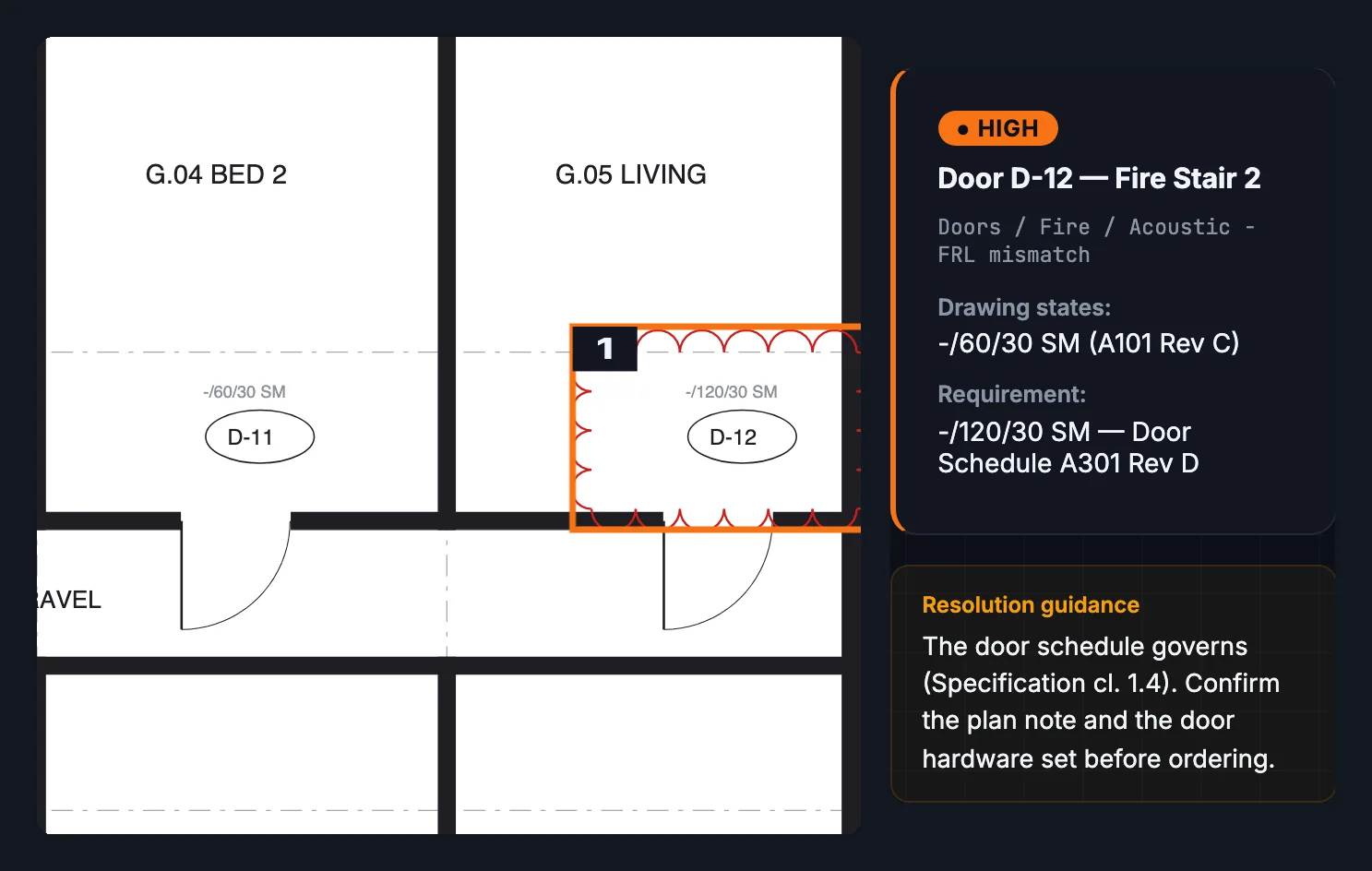
Document reconciliation is the cross-checking of a design set against itself and against the standards it invokes: drawings against schedules, schedules against specifications, specifications against the NCC and the Australian Standards it references. It answers a narrower question than design review. Design review asks "is this design right?" Reconciliation asks "do these documents agree with each other and with what the specification says they must comply with?" — and on real projects, they frequently do not.
The distinction matters because the failures are different. A design error is one consultant being wrong. A reconciliation failure is two documents each plausibly right but incompatible: a door schedule saying D1.07 is -/60/30 while the fire engineering drawing shows that wall as a -/120/- boundary; a finishes schedule specifying a tile with no slip rating in a location the specification requires one; a footing design assuming a site class the geotech report does not support. Nobody owns the gap between documents, so the gap is where problems live.
The standards landscape, briefly
Australian building compliance is layered. The National Construction Code (NCC, incorporating the BCA) sets performance requirements and deemed-to-satisfy pathways. The DTS pathways reference Australian Standards — AS 1428.1 for access, AS 1288 for glass, AS 3740 for wet-area waterproofing, AS 3959 for bushfire construction, AS 2870 for residential slabs and footings, among many. The project specification then invokes particular standards and editions, and the drawings and schedules are supposed to embody them. Add the contract layer — under AS 4000-style conditions the order of precedence between documents is itself contractual — and you have at least four layers that must agree.
Reconciliation failures occur between layers: the spec cites a standard the drawings ignore; the drawings show a detail the schedule contradicts; the BAL assessment says one thing and the window schedule another. State-level regimes (QBCC in Queensland, NSW Fair Trading and the Design and Building Practitioners regime in NSW) increasingly put personal accountability on the practitioners who declare these documents compliant — which sharpens the incentive to find contradictions before declaring, not after.
Why manual cross-checking fails at scale
A single cross-check is easy: open the door schedule, open the fire plan, compare D1.07. The problem is combinatorial. A mid-size residential building has hundreds of doors, dozens of wet areas, thousands of glazed panels — each an instance of a check across two or three documents, any of which can change at each revision. Three failure modes recur:
- The check happens once. The set is reconciled at tender, then thirty revisions arrive and nobody re-runs the comparison. Every revision silently invalidates prior checking — which is why compliance checking and document control are the same problem wearing different clothes.
- The check happens by sampling. Twenty doors of two hundred get compared, on the assumption errors are uniform. They are not; they cluster where documents were edited independently.
- The check has no evidence. "Reviewed, generally acceptable" in a report is not traceable. When a surveyor asks how a conclusion was reached, a finding must cite the documents, pages and values it compared.
This is the class of work that automates well: extract every tagged element, match instances across documents, flag disagreements with citations, and hand a human a worklist instead of a haystack. What does not automate is the judgement — whether a flagged disagreement matters, whether a performance solution covers it, whether the finding is confirmed or dismissed. The machine proposes with evidence; a qualified person decides and signs. That division is the design principle behind ParitySense's discipline checks.
Discipline by discipline
Fire and acoustic doors
Door tags, FRLs (the NCC's fire resistance level notation — structural adequacy / integrity / insulation, e.g. -/60/30) and acoustic Rw ratings must reconcile across architectural plans, the door schedule, fire engineering documentation and the specification. The classic defect is a schedule cell that lags a fire plan revision. Full treatment: fire and acoustic door scheduling.
Wet-area waterproofing
AS 3740 governs waterproofing of wet areas in residential buildings; the documentation questions are whether membrane extents, falls and setdowns are actually drawn, dimensioned and consistent between architectural plans, wet-area details and the hydraulic set. Waterproofing failures dominate defect statistics, and the documentation gap is usually visible in the set beforehand. See waterproofing documentation under AS 3740.
Accessibility
AS 1428.1 sets the design requirements for access and mobility that the NCC's access provisions invoke: door circulation spaces, ramp gradients and landings, accessible sanitary facilities. These fail reconciliation geometrically — a corridor narrowed at Rev D eats a latch-side clearance drawn at Rev B. See accessibility in design documentation.
Safety glazing
AS 1288 governs the selection and installation of glass in buildings, including where safety glazing is required — doors, low-level glazing, bathrooms and other human-impact locations. The reconciliation failure is a window schedule that never distinguishes the panels the standard treats differently. See safety glazing under AS 1288.
Bushfire
AS 3959 specifies construction requirements for buildings in bushfire-prone areas by BAL rating. The BAL assessment is one document; the requirements it triggers land across windows, doors, decks, roofing and penetrations in everyone else's documents — the definitive flow-through problem. See BAL ratings and AS 3959.
Geotechnical and footings
AS 2870 classifies residential sites by reactivity and links footing design to that classification. The geotech report and the structural footing design are produced by different parties months apart, and the check that they agree — site class, founding conditions, the report's specific recommendations — is the reconciliation nobody does. See geotech report vs footing design.
The contract layer
Reconciliation extends past technical documents. Tender documents versus executed contract documents, addenda flow-through, and precedence between inconsistent documents under AS 4000-style conditions are the commercial equivalents of a door-schedule mismatch, with the same structure: two documents, one truth, money in the gap. Those are covered in the tender-to-contract risk guide and contract precedence under AS 4000.
Running reconciliation as a process
- Establish the set. You cannot reconcile documents you have not registered. Current revisions, known status, paired predecessors — the document control layer comes first.
- Check at defined gates. Tender, contract execution, each "for construction" issue, and each revision cluster touching a checked discipline. A revision to the fire plan re-triggers the door check automatically; that is the point of automating it.
- Findings, not comments. Each discrepancy is a record: check type, severity, the documents and values compared, its status (open, confirmed, dismissed) and who decided. Dismissals with reasons are as valuable as confirmations — they are the proof the check was done.
- Close the loop. Confirmed findings become RFIs or design instructions with the evidence attached, and stay linked to the revision that resolves them. See RFI best practice.
- A human signs. Whatever produced the findings, a qualified person adjudicates them and the sign-off is theirs. Automation accelerates the review; it does not hold the liability. More on that boundary in AI and professional sign-off.
FAQ
What is document reconciliation?
Cross-checking a design set against itself and the standards it invokes — drawings vs schedules vs specifications vs the NCC pathway — to find contradictions before they are priced or built.
How do the NCC and Australian Standards relate?
The NCC sets performance requirements; its deemed-to-satisfy provisions reference Australian Standards as compliance means; the project specification invokes particular standards and editions that the drawings must then embody.
Who is responsible for catching cross-document conflicts?
Formally, each consultant for their documents and the certifier for the set. Practically, conflicts live between disciplines and are found by whoever reconciles the set — too often, by site.
Can this be automated?
The extraction and matching, yes — with cited evidence per finding. The adjudication and sign-off, no. Machines propose; qualified humans decide.
Run it through ParitySense alongside your manual review and measure the delta.
See how it works